
The wellness stack is a front door. Here's what's behind it.
Consumer-grade experience, clinical-grade data

[If you haven't read Part 1, on why Gen Z is pouring money into their bodies instead of houses, start there.]
I spend a lot of time thinking about what’s being built at the intersection of AI, healthcare, and hardware.
And the more I look at it, the more I think the consumer wellness stack that everyone’s currently spending on is actually the least interesting part of the story.
The $40 Pilates class is real, the Oura Ring is real, friends are paying for Whoop bands, creatine, AG1, and monthly therapy, and none of it is going away.
But underneath all of that, a completely different category is being built. One that isn’t about optimising your morning routine but about fundamentally changing how disease gets detected, treated, and prevented.
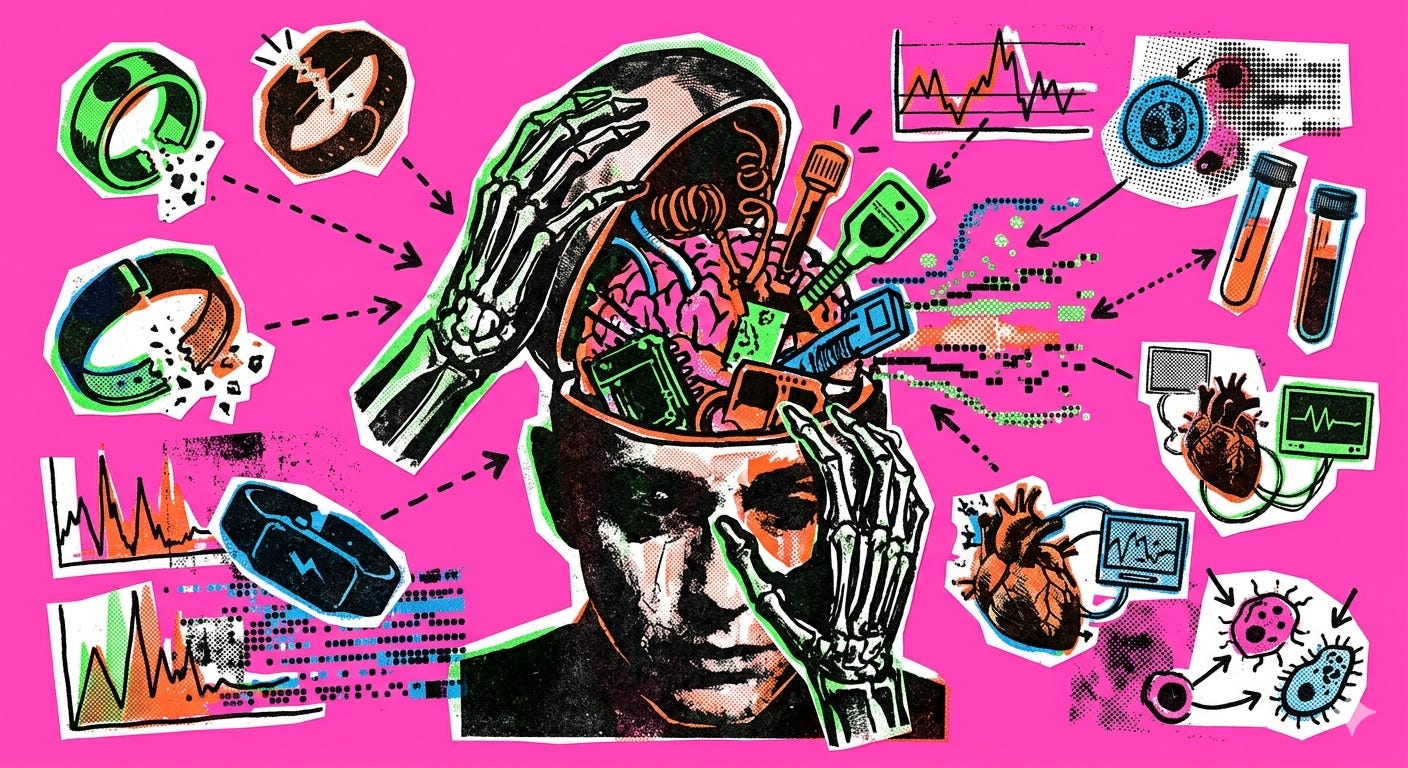
CES 2026 gave a pretty good preview of where this is heading. Withings showed its Body Scan 2, a smart scale that measures 60 health metrics, including arterial stiffness, cardiac efficiency, and metabolic health, in 90 seconds. A company called Hormometer debuted a saliva-based cortisol test you can take at home and analyze through an AI app.
NAOX unveiled headphones with built-in EEG, designed to make brain activity monitoring something you can do from your couch. Lenovo showed Qira, an AI health assistant that pulls data from your wearables and actually tells you what to do with it. And Vivoo introduced a smart menstrual pad that measures FSH levels to track fertility and hormonal health.
None of these is just tracking for tracking’s sake.
They’re all reaching toward the same idea: turning the body into a continuous data source and then using AI to make that data actually mean something.
The place I keep coming back to is the gap between what people are spending on wellness and what they’re actually getting back in clinical value. And to be fair, people are working on this. It’s not an empty space.
But the progress is uneven, and the pieces haven’t connected in the way they need to.
Take the data fragmentation problem.
Your Oura ring doesn’t talk to your Whoop, your Whoop doesn’t talk to your doctor, and your doctor has no idea what your HRV looked like the week before you got sick.
(Do you know: you should not do any intense physical activties until 2 days before any blood work)
Companies like Terra, Junction, and Metriport are building APIs to unify wearable data, and Apple HealthKit and Google Health Connect are doing it at the platform level. Epic, the biggest EHR system in the U.S., already supports connecting Fitbit and HealthKit data to clinical records at thousands of hospitals.
So the plumbing is being built.
But the end-to-end experience, where your wearable data actually flows into your doctor’s decision-making in a way that changes your care, that still doesn’t exist for most people.
The infrastructure is there in pieces. The killer product that ties it all together hasn’t arrived yet.
Then there’s personalisation. This one has moved further than people give it credit for.
Zoe is doing genuinely interesting work on personalised nutrition based on gut microbiome and blood sugar responses. Function Health is running comprehensive blood panels with AI-driven analysis. Oura itself keeps getting smarter about connecting sleep data to readiness and recovery.
But most of this personalisation is still siloed by category. Your sleep app knows about your sleep, your nutrition app knows about your food, your fitness tracker knows about your workouts. None of them talk to each other in a way that gives you an integrated picture of your health.
The real opportunity isn’t personalisation within a single category. It’s personalisation across your whole health picture. And that requires solving the data problem first.
There’s also a more fundamental issue underneath all of this.
Most wellness apps simply don’t have enough history on any individual user to say anything genuinely meaningful. Personalisation requires longitudinal data. Months and years of tracking, not weeks.
The companies that crack retention long enough to build that depth of data on their users are going to have a serious structural advantage that’s very hard for anyone else to replicate.
The third gap, and the one I think is genuinely the most underbuilt, is access.
The wellness industry as it currently exists is overwhelmingly an affluent consumer category.
Planet Fitness has figured out the $10/month gym. But for the premium wellness stack (wearables, supplements, boutique fitness, preventive testing) there isn’t really an equivalent affordable tier.
Most of the innovation is still designed for people who can comfortably spend $200+ a month on health optimization. The B2B2C model, where wellness platforms get sold through employers and health insurers, is growing as a workaround.
And the unit economics are better. But direct-to-consumer affordable wellness that reaches the people who arguably need preventive health tools the most?
That’s still largely missing. And it’s not just a social good argument. It’s a market size argument too.
What’s actually being built underneath all of this
The thing that excites me most isn’t any of the consumer-facing stuff. It’s the convergence happening at the clinical layer, where AI, healthcare, and hardware are intersecting in ways that weren’t possible even a few years ago.
AI-powered healthcare and biotech startups raised $10.7 billion in 2025. Already 24% ahead of 2024’s full-year total before the year was even over. And AI-enabled startups are raising 83% more per deal on average than non-AI healthcare companies.
That funding premium tells you everything about where investor conviction is sitting right now.
On the brain, Beacon Biosignals raised $86 million to build an FDA-cleared wearable EEG device that gives you clinical-grade brain data at home. The same quality as an overnight lab sleep study, without the lab. The brain has been the hardest organ to get real data on outside of hospital settings. And they’re using it to find new biomarkers for neurological and psychiatric conditions. The hardware captures the data continuously. And the AI is what turns it into something clinically useful.
That’s basically the pattern you see across this whole space.
On the heart, cardiovascular disease still kills 18 million people a year globally. And the data problem is fundamentally the same. Your smartwatch tracks heart rate. But that information sits in an app nobody looks at.
What’s being built now is different.
Researchers are running randomised controlled trials using consumer wearables to evaluate atrial fibrillation treatments. And AI models are being trained to detect cardiomyopathies from point-of-care ultrasound. The innovation isn’t the device itself.
It’s the AI layer that turns continuous passive data into an early warning system.
On cancer, the pace of change is genuinely hard to follow. PathAI got FDA clearance in June 2025 for a digital pathology platform. Letting pathologists make primary diagnoses from digital slides instead of shipping physical glass.
Tempus AI, which went public in 2024, processes genomic and clinical data to help oncologists make real-time personalised treatment decisions. Freenome is building a liquid biopsy platform that uses AI to detect colorectal cancer from a simple blood draw. And Xaira Therapeutics launched with $1 billion in committed funding.
Using AI for molecule design and compressing a drug discovery timeline that used to run 10–15 years.
And then there’s the hardware piece, which I personally find most exciting and most underappreciated.
The next generation of devices isn’t another ring or another watch. It’s sensors that go places watches can’t. Under the skin, into the bloodstream, embedded in fabric.
Biolinq just got FDA clearance in September 2025 for the first needle-free glucose sensor. A skin-applied patch that measures glucose from just beneath the surface without a single needle.
Ceribell has made a device that a nurse can apply in under five minutes to get brain activity data in an ICU. These aren’t consumer wellness products. They’re medical instruments being miniaturised and made accessible.
The thread running through all of it is the same insight: The data has always been in the body. We just didn’t have the hardware to capture it continuously. Or the AI to make it mean something.
Both of those problems are being solved at the same time.
Which is why this convergence feels like a genuine inflection point rather than incremental progress.
And here’s the part that connects back to everything in Part 1.
The consumer wellness stack that Gen Z is currently spending on: the rings, the classes, the supplements, is creating a generation that is already comfortable with biometric data.
Already paying for health tracking. Already thinking about their body as something to actively manage rather than just treat when something goes wrong.
That’s a massive behavioural shift. And it creates the demand surface that makes the clinical hardware layer commercially viable in a way it hasn’t been before.
The most interesting white space right now is probably the bridge between consumer and clinical. Products that are consumer-grade in their experience but clinical-grade in their data. Sitting at the exact point where your Oura ring stops being useful and your doctor’s visit begins.
That gap is narrowing.
But it’s still enormous.
And worth a lot to whoever closes it first.
Thank you for reading. More of my writings live here, and learn About Me.
If you found this interesting, I'd love to hear your thoughts. Share it on Twitter, LinkedIn or reach out at monalidambre710[at]gmail[dot]com.